
 2026 IEEE International Conference on Acoustics, Speech, and Signal Processing
2026 IEEE International Conference on Acoustics, Speech, and Signal Processing
4-8 May 2026, Barcelona, Spain
Most Upvoted
Sustainability

Sustainability Approach
A structured sustainability approach is applied to the planning, delivery, and evaluation of the conference, based on experience gained through its formal introduction in 2025. The approach was first implemented at the 2025 conference held in Hyderabad, India, hosted at the Hyderabad International Convention Centre (HICC) and the Novotel Hyderabad Convention Centre Hotel. It was developed and tested within the practical constraints of a large-scale international scientific event, establishing a consistent framework for transparency, accountability, and continuous improvement.
The experience from 2025 demonstrated how sustainability considerations can be integrated into conference delivery in a structured and proportionate way. For this ICASSP26 edition, sustainability guidelines were established within the broader conference framework, and the local organizing committee has incorporated these principles into the event planning to the extent possible within the given planning stage. Ongoing efforts aim to ensure even earlier alignment and integration in future conferences.
The approach also recognises that, as organisers of a large international event, not all impacts can be directly controlled. Action is therefore focused on areas where decisions can be taken by the organisers, as well as areas where behaviours and choices can be influenced through guidance, design, and communication. Other aspects, particularly those linked to individual travel and external factors, remain outside direct organisational control.
Sustainability is embedded across the full event lifecycle — from early planning and procurement to on-site delivery and post-event review. The approach is guided by the AIMS framework (Affordable, Inclusive, Memorable, and Sustainable) and grounded in the principles of sustainability as a core value, local engagement and support, education and awareness, transparency and accountability, and continuous improvement.
Performance is reviewed using defined indicators, allowing actions taken and outcomes achieved to be documented and assessed. This ensures that sustainability measures can be implemented and evaluated without introducing unnecessary operational complexity during conference delivery.
Sustainability Framework and Performance Indicators
The sustainability approach is structured around four core pillars. Each pillar defines a key area of focus and is supported by specific Key Performance Indicators (KPIs) used to measure delivery, monitor progress, and support transparent reporting. The KPIs focus on areas within organisational control or influence, reflecting the realities of delivering a large-scale international conference.
Operational Sustainability Excellence
This pillar focuses on integrating practical measures across core operational areas, including catering, materials, waste management, transport, and venue operations.
Key Performance Indicators
Sustainable Food
- 70% of all meals vegetarian and locally sourced (within a 160 km radius).
- Food Donation Program: Safe, surplus edible food donated to accredited local organizations
- Materials: 80%+ of all signage and branding digital or produced using more sustainable materials
Waste Reduction
- Reduce food waste, and use of single-use plastic in all areas of the event
- Eliminate polystyrene and PVC
- Waste Diversion Rate: 50%+ of event waste diverted from landfill through effective segregation and recovery processes
Measurement
- 100% of major emission sources measured and included in the ICASSP’s carbon footprint report.
Participant Engagement
This pillar addresses how attendees are informed and involved in sustainability efforts through clear guidance, programme content, and visible initiatives.
Key Performance Indicators
Awareness
- 100% of registered participants informed about sustainability measures through pre-event and on-site communications.
Program - Incorporate event sustainability content into keynotes, sessions, and other deliverables, aligning with the conference program areas.
Feedback - 30%+ of attendees providing feedback on sustainability efforts through post-event surveys or the event app.
Communications and Reporting
This pillar focuses on ensuring that sustainability actions and outcomes are communicated clearly and consistently before, during, and after the conference, supporting transparency and accountability.
Key Performance Indicators
Visibility
- Sustainability messaging integrated across all on-site engagement touchpoints.
Post-event Reporting - Distribution of a sustainability report summarising sustainability actions and outcomes.
Community Engagement
This pillar reflects efforts to support the local economy and community through sourcing and partnerships, where feasible, recognising the role of the conference within its host location.
Key Performance Indicators
Community Engagement
- Locally made goods provided in the delegate kit to support the local economy.
Venue
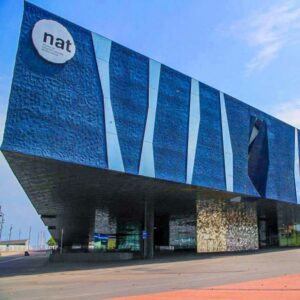
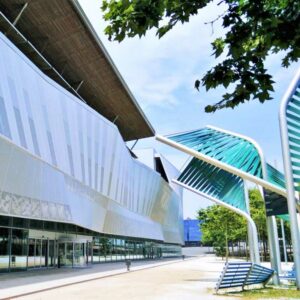
ICASSP 2026 takes place at the Barcelona International Convention Centre (CCIB), which applies a sustainability strategy based on Environmental, Social and Governance (ESG) criteria. This approach provides a structured framework for managing environmental performance, social responsibility, and governance practices within the scope of venue operations and event delivery.
CCIB holds internationally recognised certifications relevant to conferences and congresses, including ISO 20121 for Sustainable Event Management, ISO 22000 for Food Safety, ISO 50001 for Energy Management, and the Biosphere certification for Responsible Tourism. These certifications support a systematic approach to managing events, energy use, and operational processes.
The venue aligns its sustainability actions with selected United Nations Sustainable Development Goals (SDGs), focusing on areas where its activities and sector can make a direct contribution. Since 2011, CCIB has published an annual sustainability report covering environmental, social, and governance indicators. These indicators are defined through a materiality analysis in line with Global Reporting Initiative (GRI) standards and reflect the priorities of key stakeholders, including event organisers, suppliers, employees, and the local community.
The electricity consumed at the CCIB comes 100% from renewable energy sources, with 40% generated at wind energy plants exclusively to CCIB and Fira Barcelona. The remaining 60% is also of renewable origin and, although the specific source is not identified, it is certified by the Spanish National Commission on Markets and Competition (CNMC).
In terms of energy for heating and cooling network, we work with Districlima, a high-efficiency energy plant located in the Fórum area, just 1.5 km from CCIB. It produces hot and cold water, which is distributed through the district heating and cooling network to 190 companies in the district (Fórum and 22@ areas).
Almost all the heat and part of the cooling are produced using steam generated from the incineration of municipal solid waste (MSW) at a neighbouring waste management facility. The remaining cooling is produced by electric chillers that are cooled using seawater. This water is drawn from Port del Forum and returned to the sea through a collector.
Further information on CCIB’s sustainability strategy and reporting is available at: https://ccib.es/en/sustainability/
Materials
Under the ICASSP sustainability framework, operational decisions are guided by the Operational Sustainability Excellence pillar, including KPIs related to materials management, waste reduction, and waste diversion from landfill. In this context, carpet used for the conference is sourced from suppliers located within the Barcelona region to support shorter-distance operations and local sourcing.
The carpet used for ICASSP 2026 is produced by Veltex at its facility in Viladecavalls, Spain. After the event, the material is collected and transported to a waste treatment facility operated by Foment del Reciclatge in Sabadell, also located within the same regional radius. At the treatment facility, the carpet is processed to remove unsuitable elements. The remaining material is converted into Refuse-Derived Fuel (RDF) and used as an alternative fuel in industrial processes such as cement production and energy generation. This approach supports the conference waste management objectives by directing materials into controlled recovery streams and contributing to the target of diverting event waste from landfill.
Transportation
Transportation arrangements for ICASSP 2026 support lower-emission mobility options within Barcelona, recognising that local transport is an area where participant choices can be positively influenced. The city provides an extensive and integrated public transport network connecting Barcelona El Prat Airport, CCIB and beyond.
See all the details regarding transportation at Getting There.
Water
Barcelona primarily sources its water from the Llobregat River, which flows into the Mediterranean Sea south of the city. Before distribution, the water undergoes sanitation and desalination processes to meet quality standards for public consumption.
Rainfall in Spain has decreased over recent decades, and Barcelona’s semi-arid climate means that periods of water scarcity can occur. The Barcelona Metropolitan Area is currently experiencing prolonged drought conditions, placing increased pressure on water resources.
Within this context, responsible water use remains an important consideration during the conference.
- At the CCIB, water stations, supported by Josh Talks, are available across the venue to encourage refill and reduce the use of single-use bottles.
- Participants are encouraged to bring and use reusable water bottles by refilling at the available stations throughout the venue.
Your Contribution
Sustainability outcomes depend on the collective actions of participants. Attendees are encouraged to make informed choices within their control and contribute to reducing the overall impact of the conference.
Use Public Transport – Collect your complimentary Travel Card at registration and use it throughout the conference. Barcelona’s integrated public transport network provides efficient, lower-emission mobility across the city, including connections to and from the airport.
Reduce Food Waste and Choose Local Options – Take only what you intend to consume during meals. Catering includes a high proportion of locally sourced ingredients, and participants are encouraged to continue making similar choices when dining outside the conference.
Use Water Stations – Bring your own water bottle and use it throughout the conference. Water stations are available across the venue to support refill and reduce the use of single-use bottles.
Sort and Separate Waste – Use the designated waste stations and separate materials according to the following streams to support waste diversion and recovery processes:
- Brown: Organic
- Blue: Paper/carboard
- Yellow: Plastic/packaging
- Grey: General waste and any material stained with food/residue/drink
Use Digital Resources – Access conference information through digital platforms, including the event app, and prioritise electronic materials when engaging with exhibitors.
Results and Learnings
The ICASSP 2026 Sustainability & Legacy Program Report brings together the results and learnings from the conference, providing a transparent account of performance against the established Key Performance Indicators (KPIs), environmental measurement, participant response, and the first year of the Impact and Legacy Program. It documents achieved outcomes alongside objectives that were not met and areas where complete data was unavailable.
Key areas covered in the report include:
- Performance and environmental measurement, including results across catering, materials, waste, transport and venue operations, alongside measurement of the conference carbon and waste footprint.
- Impact and legacy, documenting the Signals of Change program and its community, citizen science and educational activities, including elements continuing beyond the conference through CTTC and local partners.
- Lessons from implementation, including data availability, waste segregation, catering quantities, procurement and opportunities to strengthen attendee and community engagement.
Detailed results, measurement methodology, limitations and recommendations are presented in the full ICASSP 2026 Sustainability & Legacy Program Report.